
You’re in a German classroom. Or a café. Or a meeting.
Someone says something. You feel it before you understand it. Your face gets hot. You want to respond — but the words won’t come. Not in German. Not fast enough.
You stay silent. And later, you replay it for hours.
If you’ve ever felt this, you already understand Natalie.
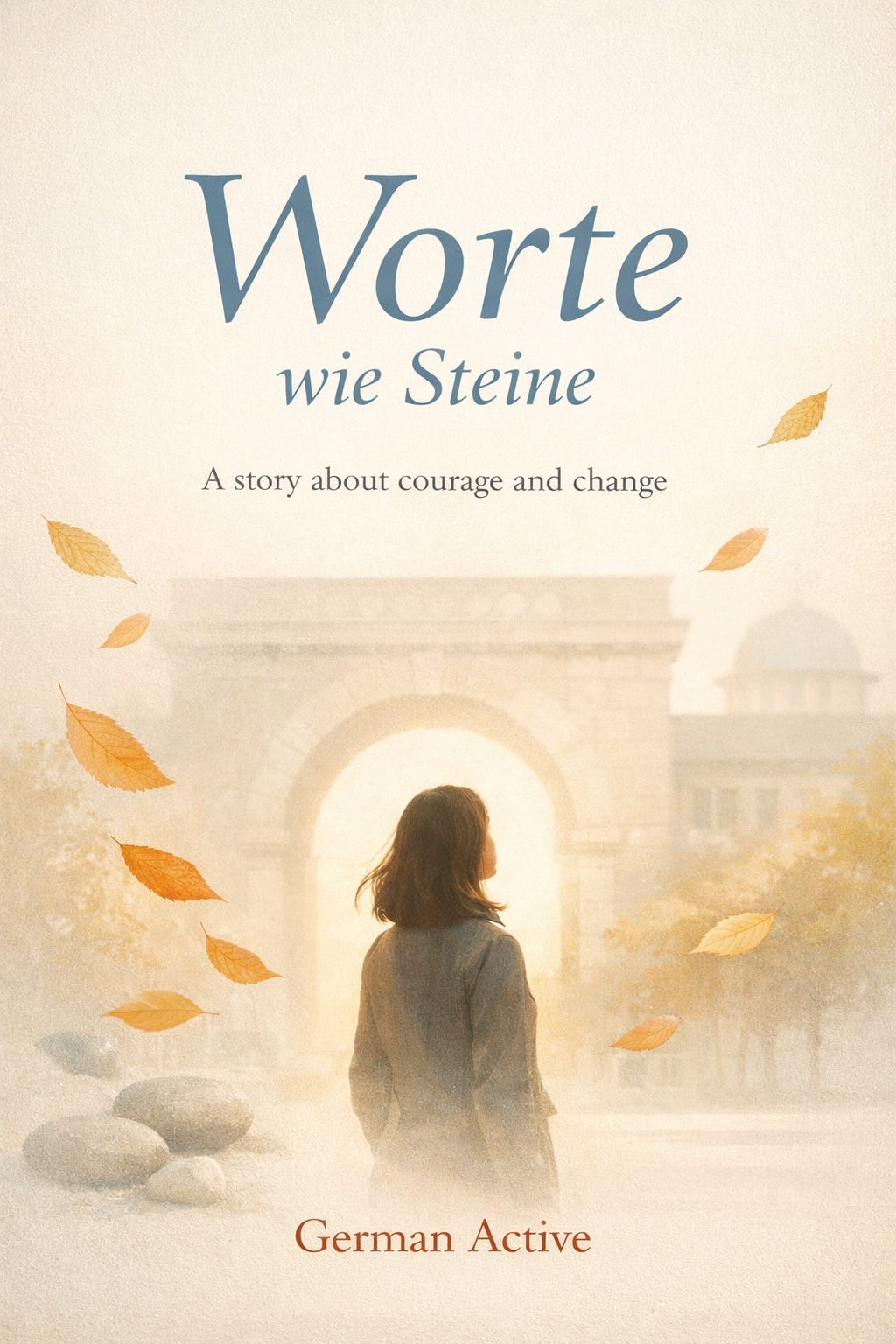
Worte wie Steine (Words Like Stones)
Natalie kommt zu spät. Der Professor sieht sie an. “Vielleicht ist das hier zu schwer für Sie,” sagt er leise. Die anderen Studenten lachen. Natalie sagt nichts. Aber innen brennt etwas.
In English: Natalie arrives late. The professor looks at her. “Maybe this is too hard for you,” he says quietly. The other students laugh. Natalie says nothing. But inside, something burns.
Simple sentences. A1 level. But you felt that, didn’t you?
That’s the whole point.
Natalie is new. She’s nervous. She’s the kind of student a certain kind of professor notices — and not kindly.
His words aren’t loud. They never are. They’re quiet, polite, and they cut.
Most people would let it go. Natalie can’t.
What she does next changes her semester. And, slowly, it changes him too.
Here’s the thing about learning German from textbooks: you memorize der Tisch, die Lampe, das Fenster. You drill Akkusativ. You pass quizzes.
And then a real German moment hits you — and you have nothing.
Stories work differently. When you follow Natalie through that classroom, your brain doesn’t translate. It feels. And feeling is how language sticks.
Every week, subscribers get two full graded German books like this one. With it:
Vocabulary lists with clean English translations
Comprehension questions that build confidence, not anxiety
Speaking prompts for when you’re ready to find your own voice
Simple A1 language — short sentences, real emotion
Cultural and social context that helps you understand why Germans say what they say
No grammar tables. No pressure. Just a story you actually want to finish.
You’ll watch Natalie find her voice in a language she’s still learning. And maybe — quietly — you’ll start finding yours.
Subscribe free below. The book is waiting for you.
Some words hurt. Some words heal. Some words — finally — come out.
Let’s learn the ones that matter.